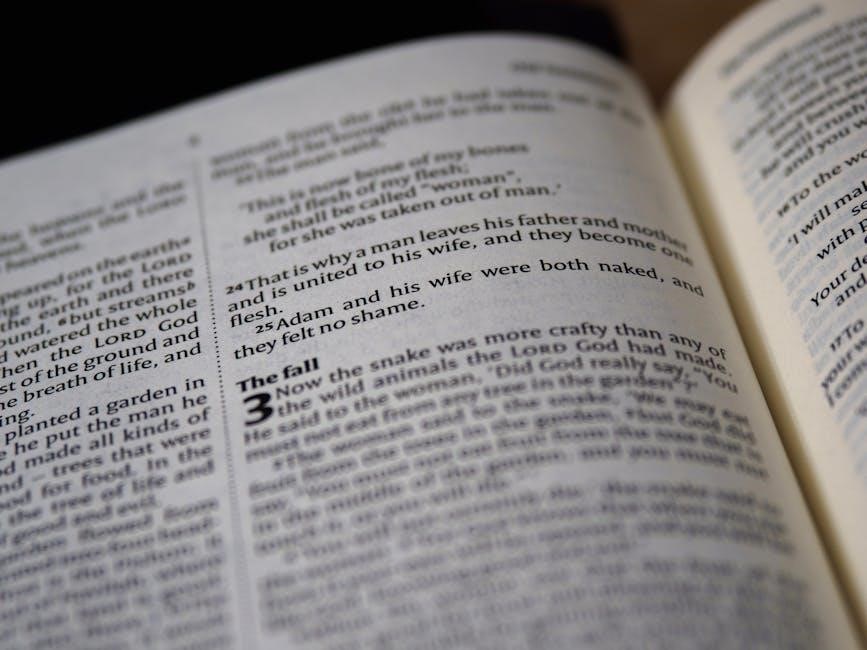
Genesis Book Summary: An Overview
Genesis, the first book, narrates creation, humanity’s fall, and God’s covenant.
It details early history, including the flood and the Tower of Babel.
Key themes involve origins, sin, and God’s promise of redemption, laying the foundation for the entire Bible.

Genesis, meaning “origin” or “beginning,” serves as the foundational book of the Bible, establishing the narrative for all that follows. It’s a book of beginnings – the creation of the universe, of humanity, of sin, and of God’s redemptive plan. The book isn’t merely a historical account, but a theological exploration of God’s character and His relationship with creation.
The authorship is traditionally attributed to Moses, though scholarly debate exists. Regardless of the precise author, Genesis draws upon ancient traditions and oral histories, skillfully woven together to present a cohesive narrative. It’s divided into two main sections: primeval history (chapters 1-11) and patriarchal history (chapters 12-50).
Primeval history recounts the creation, the fall of man, the flood, and the dispersion of nations. Patriarchal history focuses on the lives of Abraham, Isaac, Jacob, and Joseph, tracing the lineage through which God promises to bless all nations. Genesis establishes core biblical themes like covenant, faith, and the consequences of sin. Understanding Genesis is crucial for grasping the overarching story of Scripture and the unfolding of God’s plan for humanity. It’s a book that continues to resonate with readers today, offering profound insights into the human condition and the nature of God.
The Two Accounts of Creation (Genesis 1-2)

Genesis 1 presents a majestic, poetic account of creation, emphasizing God’s power and order. Over six days, God systematically creates the heavens and the earth, culminating in the creation of humanity – male and female – made in His image. This account highlights God’s transcendence and the goodness of all He creates, repeatedly declaring “God saw that it was good.” It establishes a framework of order and purpose.

Genesis 2 offers a more intimate and detailed perspective, focusing specifically on the creation of Adam and Eve. It describes the Garden of Eden, the creation of animals, and the divine purpose for humanity: to cultivate and keep the garden. This account emphasizes God’s immanence and His personal relationship with creation.
Scholars debate the relationship between these two accounts, viewing them as complementary rather than contradictory. Both emphasize God as the Creator, but they differ in focus and literary style. Together, they paint a comprehensive picture of creation, revealing God’s power, wisdom, and love in bringing the world into existence and establishing humanity as His stewards.
The Story of Adam and Eve (Genesis 3)
Genesis 3 recounts the pivotal event of the Fall, where Adam and Eve succumb to the serpent’s temptation and disobey God’s command not to eat from the Tree of the Knowledge of Good and Evil. The serpent, presented as cunning, questions God’s goodness and promises enlightenment through disobedience.
Driven by desire and a thirst for knowledge, Eve eats the forbidden fruit and then offers it to Adam, who also partakes. Immediately, they experience shame and realize their nakedness, covering themselves with fig leaves. This marks a loss of innocence and a broken relationship with God.
God confronts Adam and Eve, and they attempt to shift blame. As a consequence, God pronounces curses upon the serpent, the woman, and the man. The serpent is condemned to crawl on its belly, the woman experiences pain in childbirth and subordination to her husband, and the man faces toil and hardship in providing for his family;
Ultimately, Adam and Eve are banished from the Garden of Eden, losing access to eternal life. This event introduces sin, suffering, and death into the world, setting the stage for the rest of biblical narrative and the need for redemption.
Cain and Abel: The First Sin and its Consequences (Genesis 4)

Genesis 4 details the story of Cain and Abel, the sons of Adam and Eve, and the first instance of murder recorded in the Bible. Both offer sacrifices to God, but God favors Abel’s offering – likely a blood sacrifice of livestock – over Cain’s offering of crops.
Consumed by jealousy and resentment, Cain plots to kill his brother. Despite God’s warning against such feelings, Cain ambushes and murders Abel in a field. This act represents a further descent into sin and violence following the Fall.
God questions Cain about Abel’s whereabouts, and Cain lies, attempting to evade responsibility. God reveals his knowledge of the murder and pronounces a severe punishment upon Cain: he is cursed to wander the earth as a fugitive and vagabond, unable to cultivate the land.
Cain expresses his fear of retribution, but God provides him with a sign – a mark – to protect him from being killed. Despite his punishment, Cain is allowed to live, demonstrating God’s mercy even in judgment. This story illustrates the devastating consequences of sin, jealousy, and the importance of righteous living.
The Lineage of Adam and the Rise of Wickedness (Genesis 5-6)
Genesis 5 presents a genealogical record tracing the descendants of Adam through Seth, highlighting the increasing lifespan of early humans. This chapter emphasizes the image of God in humanity, noting each patriarch “lived and died” – a stark contrast to the potential for eternal life before the Fall.
However, as the generations progress, Genesis 6 reveals a dramatic increase in wickedness and violence on Earth. The “sons of God” (interpreted variously as fallen angels or powerful human rulers) intermarry with the “daughters of men,” producing a race of giants known as the Nephilim.
This unholy union and the widespread corruption deeply grieve God. He observes that “every inclination of the thoughts of their hearts is only evil all the time.” Consequently, God resolves to cleanse the earth of its wickedness through a catastrophic flood.
Despite this impending judgment, a righteous man named Noah finds favor in God’s eyes. God instructs Noah to build an ark to preserve himself, his family, and representatives of all living creatures, foreshadowing the coming deluge and a new beginning for humanity.
The Great Flood and Noah’s Ark (Genesis 7-9)
Genesis 7 details the execution of God’s judgment. Rain falls for forty days and forty nights, and the “fountains of the great deep” burst forth, causing a global flood that covers even the highest mountains. All living creatures outside the ark perish, fulfilling God’s decree to cleanse the earth of wickedness.
Genesis 8 recounts the gradual receding of the floodwaters. Noah sends out a raven and then a dove to determine if the land is dry, eventually receiving confirmation when the dove returns with an olive branch. This symbolizes a new beginning and God’s renewed relationship with creation.
Genesis 9 marks God’s covenant with Noah and all living creatures. God promises never again to destroy all life with a flood, establishing the rainbow as a sign of this covenant. He also grants humanity permission to eat meat but prohibits consuming blood.
Furthermore, God reaffirms the sanctity of human life, establishing laws against murder and commanding humans to populate the earth. This section signifies a fresh start for humanity, guided by God’s grace and a renewed commitment to preserving life.
The Table of Nations and the Tower of Babel (Genesis 10-11)
Genesis 10 presents a genealogical “table of nations,” listing the descendants of Noah’s sons – Shem, Ham, and Japheth – and tracing the origins of various peoples and nations across the earth. This chapter demonstrates how humanity repopulated the world after the flood, diversifying into distinct cultural and linguistic groups.
Genesis 11 introduces the story of the Tower of Babel. United in language and purpose, humanity attempts to build a tower reaching to heaven, symbolizing their ambition to make a name for themselves and defy God. God, observing their pride and potential for unchecked power, confuses their language, scattering them across the earth.
This act of divine intervention explains the diversity of languages and the dispersion of people, fulfilling God’s earlier command to fill the earth. The name “Babel” itself signifies confusion, highlighting the consequences of human arrogance and disobedience.
Ultimately, these chapters illustrate God’s sovereignty over human endeavors and his plan to spread humanity across the globe, while also cautioning against the dangers of pride and unity based on rebellion against Him.
The Call of Abraham and the Covenant (Genesis 12-13)
Genesis 12 marks a pivotal moment: God calls Abram (later Abraham) to leave his country and family for a land He will show him. This call isn’t merely a geographical relocation, but the initiation of a divine plan to establish a great nation through Abraham and bless all peoples through his lineage.
God promises Abraham land, offspring as numerous as the stars, and blessing – a covenant relationship built on faith and obedience. Abraham, despite initial hesitation, trusts God and journeys to Canaan. He builds an altar, signifying his worship and commitment to the covenant.
Genesis 13 details a famine forcing Abraham and his nephew Lot to separate due to insufficient resources. Demonstrating humility and faith, Abraham allows Lot to choose the best land, showcasing his character and prioritizing peaceful relations.
God reaffirms His covenant with Abraham, promising him countless descendants and the land of Canaan as an everlasting possession. These chapters establish Abraham as the father of faith and the foundation for God’s redemptive plan.
Abraham and Lot Separate (Genesis 13)
Genesis 13 recounts the increasing wealth of both Abraham and Lot, leading to conflict between their herdsmen due to limited pastureland in Canaan. The land couldn’t sustain both their growing flocks and possessions, necessitating a separation to avoid strife and potential violence.

Abraham, demonstrating remarkable generosity and a desire for peace, proposes a division of territory to Lot. He offers Lot the first choice, allowing him to select the most desirable land, showcasing his humility and prioritizing harmonious relationships over personal gain.
Lot, captivated by the fertile plains of the Jordan River, specifically the area near Sodom, chooses to settle there. This decision, while seemingly advantageous, ultimately places him in proximity to wicked cities, foreshadowing future consequences.
Following Lot’s choice, God reaffirms the covenant with Abraham, promising him the entire land of Canaan as an everlasting inheritance. This reiteration emphasizes God’s faithfulness and His continued commitment to fulfilling His promises despite the separation. The chapter highlights themes of generosity, faith, and divine providence.

The Promise of a Son: Isaac’s Birth (Genesis 15-21)
Genesis 15-21 details God’s reaffirmation of the covenant with Abraham, promising him a son, Isaac, despite Abraham and Sarah’s advanced age. Initially, Abraham expresses doubt, prompting God to illustrate the certainty of the promise through a symbolic covenant ceremony involving divided animals.
Years pass, and Sarah, initially barren, conceives and gives birth to Isaac, fulfilling God’s promise. Isaac’s birth is a miraculous event, demonstrating God’s power and faithfulness. The name “Isaac” itself signifies laughter, reflecting the initial disbelief and subsequent joy surrounding his arrival.
However, God tests Abraham’s faith by commanding him to sacrifice Isaac as a burnt offering. Abraham willingly obeys, demonstrating unwavering devotion, but at the last moment, God intervenes, providing a ram as a substitute sacrifice.
This pivotal event foreshadows the ultimate sacrifice of Jesus Christ. Following the test, God blesses Abraham abundantly, reiterating the covenant promises and establishing a lasting legacy through Isaac. Hagar and Ishmael are also sent away, securing Isaac’s inheritance.
The Test of Abraham: Sacrifice of Isaac (Genesis 22)

Genesis 22 recounts God’s profound test of Abraham’s faith, commanding him to offer his beloved son, Isaac, as a burnt offering. This command is shocking, as Isaac was the son of promise, through whom God’s covenant would be fulfilled.
Abraham, without hesitation, prepares to obey, demonstrating complete trust in God’s sovereignty. He journeys to Mount Moriah with Isaac, carrying the wood for the sacrifice, and binds his son. As Abraham raises the knife to slay Isaac, an angel of the Lord intervenes, stopping him.
God provides a ram caught in a thicket as a substitute sacrifice, signifying His acceptance of Abraham’s willingness to obey. This event is a powerful illustration of faith, obedience, and the foreshadowing of the ultimate sacrifice of Jesus Christ.
Abraham’s unwavering devotion is rewarded with a renewed covenant promise, including the multiplication of his descendants and blessings upon all nations. This test solidifies Abraham’s status as a man of faith and demonstrates God’s provision and faithfulness.
Isaac and Rebekah: The Birth of Jacob and Esau (Genesis 24-25)
Genesis 24 details Abraham’s servant’s journey to find a wife for Isaac from among his relatives in Mesopotamia. Guided by divine intervention, he finds Rebekah, who willingly returns with him to Canaan, becoming Isaac’s wife.
Genesis 25 narrates the birth of their twin sons, Esau and Jacob; Esau, the elder, is a skilled hunter and man of the field, favored by his father, Isaac. Jacob, the younger, is a quiet man who stays among the tents, favored by his mother, Rebekah.
From birth, a rivalry develops between the brothers. Esau, in a moment of desperation, sells his birthright – the privileges associated with being the firstborn – to Jacob for a bowl of lentil stew. This act foreshadows the future conflict and highlights Jacob’s cunning.
The narrative establishes the foundational family dynamics that will drive much of the subsequent story, setting the stage for Jacob’s eventual inheritance of the covenant promises made to Abraham and Isaac. Their differing personalities and choices are central to the unfolding drama.
Jacob’s Deception and Flight to Haran (Genesis 27-28)
Genesis 27 recounts Jacob, with his mother Rebekah’s assistance, deceiving his aging and nearly blind father, Isaac, to receive the blessing intended for his older brother, Esau. Rebekah orchestrates the plan, dressing Jacob in Esau’s clothes and covering his smooth skin with goatskin to mimic his brother’s hairiness.
Isaac, unknowingly bestowing the blessing upon Jacob, grants him authority and promises of prosperity. When Esau discovers the deception, he is filled with rage and vows to kill Jacob. Rebekah, fearing for Jacob’s life, urges him to flee to her brother Laban in Haran.
Genesis 28 details Jacob’s journey to Haran. At Bethel, he experiences a profound vision of a ladder reaching to heaven, with angels ascending and descending. God reaffirms the covenant promises made to Abraham and Isaac, promising Jacob land, descendants, and protection.
Jacob, awakened from his dream, vows to dedicate a tenth of all he receives to God. This marks a turning point in his life, as he begins to actively engage with God’s promises and prepares to build a family in a foreign land.

Jacob’s Dream at Bethel and Return to Canaan (Genesis 28-31)
Genesis 28-31 details Jacob’s time in Haran, serving Laban, Rebekah’s brother. He falls in love with Laban’s younger daughter, Rachel, and agrees to work seven years to marry her. However, Laban deceives Jacob, substituting Leah for Rachel on their wedding night.
Jacob, upon discovering the deception, also marries Rachel after another seven years of service. He fathers eleven sons and a daughter, Leah and Rachel competing for Jacob’s affection. Through shrewd bargaining, Jacob accumulates significant wealth in livestock.
Genesis 31 narrates Jacob’s departure from Haran, feeling compelled by God to return to Canaan; He secretly leaves, taking his family and possessions, pursued by Laban. God warns Laban in a dream not to harm Jacob.
They reach a covenant, establishing a boundary marker. Jacob, fearing retaliation from Esau, prepares for confrontation, sending gifts ahead and praying for deliverance. This sets the stage for his eventual reconciliation with his brother and the continuation of God’s promises.
Joseph and His Brothers: From Slavery to Power (Genesis 37-50)
Genesis 37-50 recounts the dramatic story of Joseph, Jacob’s favored son, and his journey from betrayal to ultimate power in Egypt. His brothers, consumed by jealousy, sell him into slavery, falsely reporting his death to Jacob, causing immense grief.
In Egypt, Joseph rises through the ranks, interpreting Pharaoh’s dreams and becoming a high-ranking official responsible for managing the nation’s resources during a severe famine. Unbeknownst to his brothers, he holds the key to their survival.
Driven by famine, Joseph’s brothers travel to Egypt seeking food, unknowingly facing their brother who now holds their fate. Joseph tests them, eventually revealing his identity and forgiving their past actions.
Jacob and his entire family relocate to Egypt, where they are provided for by Joseph. The narrative concludes with Jacob’s death and Joseph’s assurance that God will eventually lead them back to Canaan, fulfilling the covenant promises. This section emphasizes God’s sovereignty and providence.