
Q60 Manual Swap: A Comprehensive Guide
This guide details the intricate process of swapping an automatic transmission for a manual one in an Infiniti Q60.
It explores options,
challenges,
and necessary components for a successful conversion.
The Infiniti Q60 Red Sport, while a potent performer, originally came exclusively with an automatic transmission. This has left many enthusiasts desiring a more engaging driving experience – one only a manual transmission can provide. Consequently, a growing community has begun tackling the complex, yet rewarding, Q60 manual swap. This undertaking isn’t simply a bolt-on affair; it requires significant mechanical skill, research, and a willingness to overcome hurdles.
The appeal stems from a desire for greater control and driver involvement. The new Nissan Z, often cited as a benchmark, offers a manual option and shares mechanical similarities, hinting at potential direct-fit solutions. However, the swap involves more than just the transmission itself. Considerations include clutch compatibility, ECU recalibration, and potentially, custom adapter plates. This guide aims to provide a comprehensive overview of the process, outlining the challenges and available pathways to achieve a truly driver-focused Q60.
Why Swap to a Manual Transmission?
The primary motivation for a Q60 manual swap is a heightened driving experience. Many enthusiasts feel disconnected from the car with the automatic, craving the direct control and engagement a manual transmission offers. This isn’t merely about performance; it’s about forging a stronger connection with the machine, dictating gear selection, and enjoying a more visceral feel.
Furthermore, a manual swap can unlock a different dimension of performance potential. While the Q60’s VR30 engine is capable, a manual allows for more precise power delivery and control during spirited driving. The absence of torque converter losses can also contribute to slightly improved efficiency. Some argue that a manual Q60 wouldn’t compete with the automatic’s sales, appealing to a niche market seeking a unique driving experience. Ultimately, the swap is driven by a passion for driving and a desire to personalize the Q60 to individual preferences.
Challenges and Considerations
Undertaking a Q60 manual swap isn’t a straightforward process; significant challenges exist. It’s not a simple “bolt-on” affair, requiring substantial mechanical skill and potentially professional assistance. Nissan doesn’t officially support this conversion, meaning no factory parts or guidance are available. Certification and calibration are major hurdles, as modifications must meet legal standards.
Wiring modifications are inevitable, demanding expertise in automotive electrical systems. The ECU will require recalibration to properly manage the manual transmission, impacting engine performance and potentially requiring custom tuning. Component sourcing can be complex, with the need for adapters or specialized parts. Costs can quickly escalate, exceeding initial estimates. Thorough research, meticulous planning, and a realistic assessment of your capabilities are crucial before embarking on this project.

Transmission Options
Several transmission choices exist for a Q60 manual swap, including the Nissan Z transmission (potentially a direct fit),
the 370Z transmission,
and utilizing an RB-series adapter from LOJ Conversions.
Nissan Z Transmission (Direct Fit Potential)

The newest Nissan Z model presents the most straightforward path for a Q60 manual transmission swap, offering significant advantages due to its inherent compatibility. Concept Z Performance highlights that the Z’s transmission would likely be a direct fit for the Q60. This is because it’s fundamentally a 370Z transmission, but with crucial upgrades tailored for the VR30 engine.
These enhancements include a modified bellhousing specifically designed to mate with the VR30, along with upgraded synchronizers on first and second gear – addressing common weak points. A particularly beneficial change is the switch to an external slave cylinder, simplifying the hydraulic clutch setup. While the transmission itself is considered a relatively minor hurdle in the overall swap, its direct-fit potential dramatically reduces fabrication and customization efforts, making it the preferred choice for many enthusiasts seeking a simpler conversion process.
370Z Transmission Compatibility
While the Nissan Z transmission offers a near-direct fit, the 370Z transmission serves as a foundational component in its design, indicating a strong level of compatibility with the Q60. However, it’s not a completely bolt-on solution and requires careful consideration. The newer Z transmission builds upon the 370Z’s base, incorporating modifications for the VR30 engine and improved durability.
Utilizing a 370Z transmission necessitates addressing the bellhousing differences and potentially upgrading the synchronizers for optimal performance, mirroring the enhancements found in the newer Z model. Furthermore, converting to an external slave cylinder is crucial for a clean and reliable clutch setup. Although requiring more adaptation than the newer Z unit, the 370Z transmission remains a viable and often more readily available option for those undertaking a Q60 manual swap, offering a balance between cost and complexity.
RB-Series Transmission Adapter (LOJ Conversions)
For those seeking a unique and potentially robust manual transmission solution, LOJ Conversions offers an adapter plate enabling the fitment of a Nissan RB-series all-wheel-drive transmission to the Q60’s VR30DDTT V6 engine. This opens up possibilities beyond the conventional 350Z or 370Z transmission routes.
The adapter is cleverly designed to retain the factory automatic transmission flexplate, simplifying some aspects of the installation. It allows compatibility with a 350Z single-disk clutch setup, a commonly recommended choice for this swap. This approach is particularly appealing for builds aiming for increased power handling and the potential for all-wheel-drive configurations. However, utilizing the RB-series adapter introduces greater complexity compared to direct-fit options, demanding meticulous planning and fabrication skills. It’s a path for experienced enthusiasts willing to embrace a more involved conversion process.

Required Components
A successful Q60 manual swap necessitates a transmission, a compatible clutch kit (350Z single disk is favored), and a flywheel.
These are core elements for the conversion.
Transmission Itself
Sourcing the correct transmission is paramount for a Q60 manual swap. The newest Nissan Z transmission presents a potentially direct fit, simplifying the process considerably. This is because it’s fundamentally a 370Z transmission, but with key upgrades. These improvements include a modified bellhousing designed to mate with the VR30 engine found in the Q60, and enhanced synchronizers on first and second gear for improved shift quality and durability.
Furthermore, the newer Z transmission utilizes an external slave cylinder, a welcome change that streamlines installation. While seemingly minor, this transmission choice significantly reduces the complexity of the swap. Alternatively, a 370Z transmission is also a viable option, though it may require more adaptation work compared to the newer Z unit. Exploring both options thoroughly, considering cost and ease of installation, is crucial before committing to a specific transmission.
Clutch Kit (350Z Single Disk Recommended)
Selecting the appropriate clutch kit is vital for a reliable and performant manual Q60. Numerous sources recommend utilizing a 350Z single-disk clutch kit for this conversion; This choice stems from its compatibility with the VR30 engine and its proven ability to handle the Q60’s power output. The adapter plate from LOJ Conversions, designed for RB-series transmissions, is specifically engineered to accommodate this 350Z clutch setup, maintaining the automatic transmission flex plate for simplified integration.
A single-disk configuration offers a balance between performance, cost, and drivability, making it an ideal choice for a street-driven Q60. Ensure the kit includes a pressure plate, clutch disc, and throw-out bearing. Prioritize a reputable brand known for quality and durability to avoid premature failure. Proper clutch selection ensures smooth engagement, efficient power transfer, and long-term reliability after the manual swap is complete.
Flywheel
A crucial component often overlooked is the flywheel; When transitioning to a manual transmission in the Q60, a flywheel specifically designed for manual applications is essential. The automatic transmission flywheel is incompatible and cannot be reused. The 350Z single-disk clutch kit recommendation extends to the flywheel; sourcing a 350Z flywheel is generally advised for seamless integration, particularly when utilizing the LOJ Conversions adapter plate for RB-series transmissions.
The flywheel’s weight influences engine responsiveness and inertia. Consider your driving style and intended use when selecting a flywheel weight. A lighter flywheel enhances acceleration and rev-matching, while a heavier one provides smoother low-speed driving. Ensure the flywheel is balanced to prevent vibrations. Proper flywheel installation, torqued to the manufacturer’s specifications, is paramount for a safe and reliable manual swap.

Installation Process
The installation involves removing the automatic transmission, installing the manual, and addressing wiring/ECU modifications. Careful planning and mechanical expertise are vital for success.
Removing the Automatic Transmission
Begin by disconnecting the battery to ensure electrical safety. Drain the transmission fluid completely, utilizing appropriate disposal methods. Next, disconnect the driveshaft, ensuring you support it to prevent damage. Detach all wiring harnesses connected to the transmission, carefully labeling each for reinstallation purposes. Remove the exhaust system components obstructing access to the transmission.
Support the engine from above to prevent it from tilting when the transmission is removed. Unbolt the transmission mounts and carefully lower the automatic transmission using a transmission jack. This step requires patience and precision to avoid damaging surrounding components. Once the transmission is fully lowered, inspect the flexplate for any damage and prepare the area for the manual transmission installation. Remember to retain the automatic transmission flex plate if utilizing the RB-Series adapter.
Installing the Manual Transmission
Carefully align the manual transmission with the engine, utilizing a transmission jack for controlled lifting and positioning. Ensure the pilot bearing is correctly seated in the crankshaft. Gently guide the transmission into place, aligning the input shaft with the clutch disc. Secure the transmission to the engine using the appropriate bolts, tightening them to the manufacturer’s specified torque.
Reinstall the transmission mounts, ensuring they are securely fastened. Reconnect the driveshaft, verifying proper alignment. Install the clutch slave cylinder, paying attention to proper bleeding procedures. Begin reconnecting the wiring harnesses, referencing the labels created during removal. Double-check all connections to prevent future issues. Finally, reinstall the exhaust system components, ensuring proper clearance around the new transmission.
Wiring and ECU Considerations
The Q60’s ECU requires significant attention during a manual swap. The automatic transmission control signals must be disabled, and manual transmission inputs enabled. This often necessitates a custom ECU tune or reflashing to properly interpret the new transmission’s data. Wiring for the clutch switch, reverse lights, and potentially a vehicle speed sensor (VSS) must be integrated.
Nissan certification demands careful adherence to these modifications. Incorrect wiring or ECU calibration can lead to operational issues or even damage; Consider utilizing a standalone ECU for greater control and flexibility. Thoroughly test all new wiring connections before starting the engine. Proper calibration is crucial for optimal performance and to avoid error codes.

Calibration and Certification
Successful completion requires meticulous ECU calibration for the manual transmission; Nissan certification is a hurdle, demanding adherence to standards for legality and safety.
Nissan Certification Requirements
Obtaining Nissan’s certification for a Q60 manual swap presents a significant challenge, as the vehicle was originally manufactured solely with automatic transmissions. Nissan would need to verify that the modified vehicle meets all applicable safety and emissions standards. This process isn’t straightforward; simply bolting components together isn’t sufficient.
The certification process would likely involve rigorous testing to ensure the manual transmission system functions correctly and doesn’t compromise the vehicle’s structural integrity or safety features. Specifically, Nissan would scrutinize the clutch, flywheel, and associated components.
Furthermore, the ECU calibration must be demonstrably safe and compliant with emissions regulations. Documentation detailing all modifications, parts used, and calibration data would be essential. Without official certification, the modified Q60 may not be legally road-worthy in many jurisdictions, potentially impacting insurance coverage and resale value. It’s a complex undertaking requiring substantial effort and expertise.
ECU Calibration for Manual Transmission
Successfully integrating a manual transmission necessitates comprehensive ECU calibration. The original automatic transmission programming is incompatible with manual operation, requiring significant adjustments to engine and transmission control parameters. This isn’t a simple plug-and-play scenario; custom tuning is crucial.
Key areas for calibration include throttle control, rev limiting, launch control, and removal of automatic transmission-related functions. The ECU must accurately interpret driver inputs from the clutch pedal and gear selection. Furthermore, optimizing the torque curve for the manual transmission’s gear ratios is vital for performance and drivability.
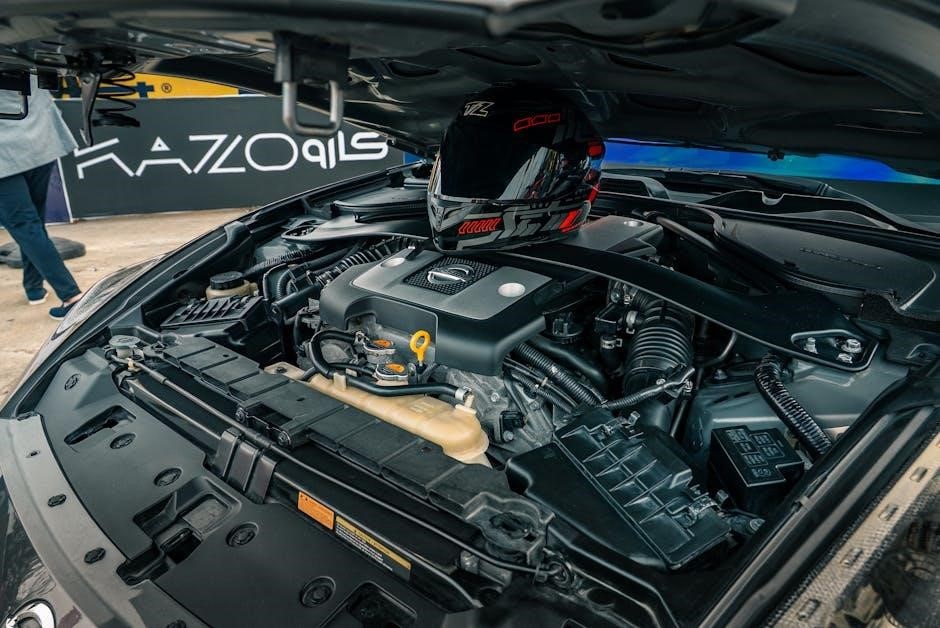
Without proper calibration, issues like stalling, rough shifting, and inaccurate speed readings can occur. Experienced tuners specializing in Nissan VR30 engines are recommended. Calibration should also account for any aftermarket components, such as the HKS blow-off valve, to ensure seamless integration and optimal performance. A dyno tune is highly advisable to validate the calibration.

Post-Installation
Following the swap, integrating components like an HKS blow-off valve enhances performance. Thorough testing and refinement are crucial for optimal results and a refined driving experience.

HKS Blow Off Valve Integration
After completing the manual transmission swap in your Q60, integrating an HKS Blow Off Valve (BOV) can significantly enhance the driving experience and potentially unlock additional performance gains. The BOV serves as a crucial component in managing boost pressure, particularly with the VR30DDTT engine’s twin-turbo setup.
When the throttle is closed during gear changes or deceleration, the BOV releases excess pressure, preventing compressor surge and ensuring smoother transitions. Several kits are available specifically tailored for the Q60/Q50 platform, simplifying the installation process. These kits often include all necessary hardware and instructions for a seamless fit.
Choosing the right BOV type – whether it’s a recirculating or vent-to-atmosphere model – depends on your desired sound and performance characteristics. Vent-to-atmosphere BOVs produce the iconic blow-off sound, while recirculating BOVs return the air to the intake, maintaining a quieter operation and potentially improving metering accuracy. Proper installation and calibration are essential to avoid any potential issues with the engine’s performance or boost control.

Testing and Refinement
Following the installation of the manual transmission and any supporting modifications like the HKS BOV, a thorough testing and refinement phase is crucial. Begin with gentle test drives, focusing on smooth clutch engagement, precise gear changes, and overall drivability. Monitor for any unusual noises, vibrations, or warning lights on the dashboard.
Pay close attention to the ECU calibration, ensuring it accurately reflects the manual transmission setup. Data logging can provide valuable insights into engine performance, boost levels, and fuel trims, allowing for fine-tuning adjustments. Road testing under various conditions – including city driving, highway cruising, and spirited acceleration – will help identify any remaining issues.
Refinement may involve adjusting the clutch pedal feel, optimizing shift points, and addressing any minor mechanical adjustments. This iterative process ensures the manual swap delivers a reliable, enjoyable, and performance-optimized driving experience tailored to your preferences.
Potential Performance Gains
A manual transmission swap in the Infiniti Q60 Red Sport offers several potential performance enhancements beyond simply driver engagement. Removing the torque converter losses inherent in an automatic transmission directly translates to increased power delivery to the wheels, improving acceleration times. The direct mechanical connection allows for more precise control over gear selection, optimizing engine RPM for peak performance.
Furthermore, the upgraded synchronizers found in newer transmissions, like those from the Nissan Z, contribute to quicker and smoother shifts. This minimizes power interruption during gear changes, maintaining momentum. The ability to fully control engine braking also enhances cornering performance and overall driving dynamics.
Combined with supporting modifications like the HKS blow-off valve, which manages turbocharger pressure, the manual swap unlocks the VR30DDTT engine’s full potential, resulting in a more responsive and exhilarating driving experience.